
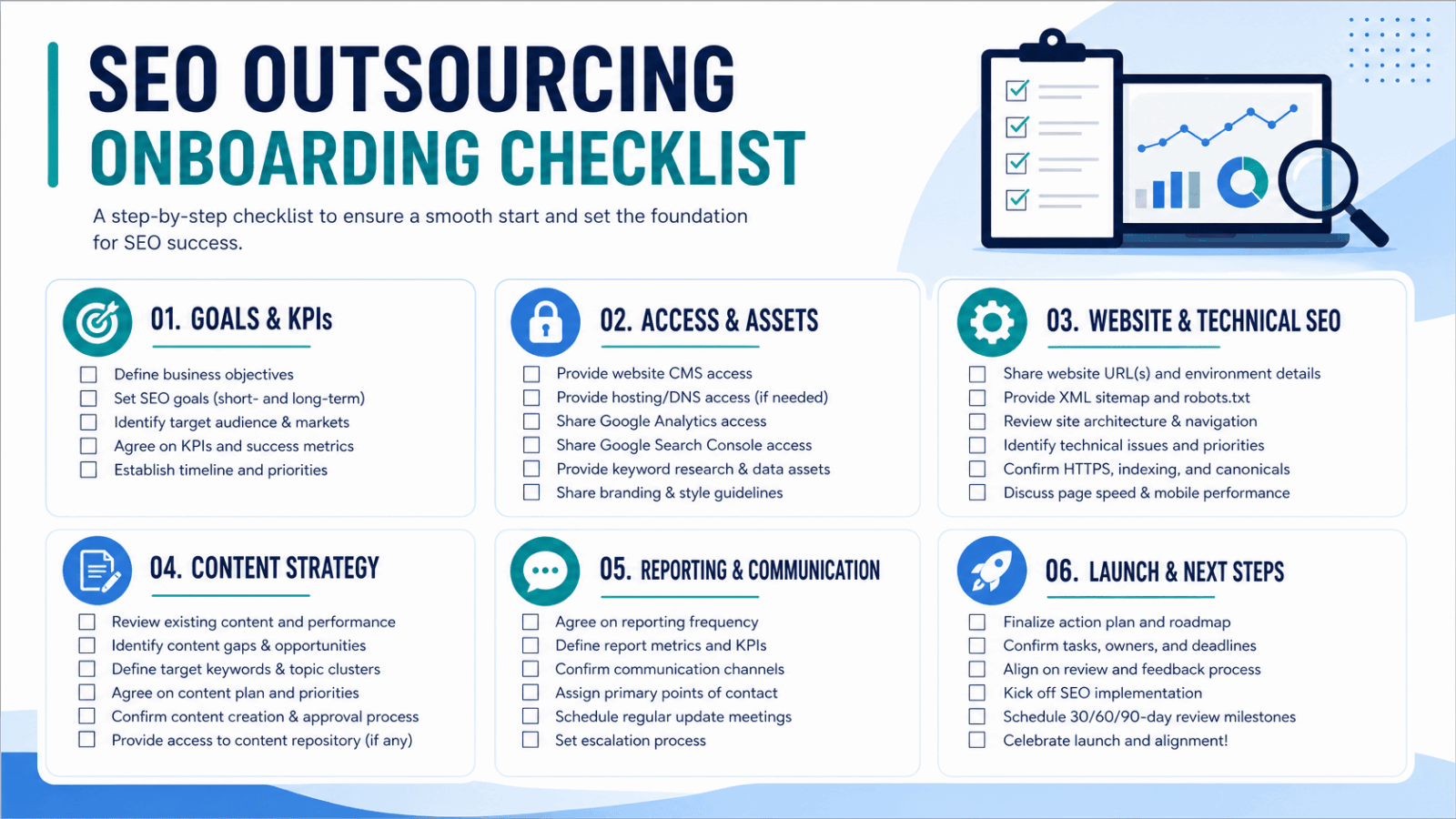
The checklist of the SEO outsourcing onboarding process helps you to determine what is to be agreed, what is to be provided or collected, and what needs to be verified before a project with an external SEO company is launched into a delivery mode: scope, responsibilities, access to accounts, the assets, tracking, the authorization, and how-to-take-the-reins.
For a company it is important to make clear the role of own team, the SEO contractor and client to enable smooth implementation.
Apply this method to set owners, locate problems, and describe what finishes every task.
The material is directed mostly to UK agencies but also provides help for organizations that want to hire or change their SEO suppliers. This planning advice is meant to be a general guide, not a specification of the publisher’s services, legal advice, or a guarantee of results.
Who this checklist is for—and when it is not enough
The checklist is for buyers organizing an external SEO contract. Use it to define the roles but get legal specialist advice about the contract if the engagement touches upon privacy, security, or regulated-content issues.
Agencies adding an outsourced partner
Link the agreement with the partner to the client’s requirements. The team who writes the brief is responsible for a communication between the client and the partner, approvals and doing delivery checks.
Businesses hiring or switching an agency
Verify ownership of the accounts, access rights, implementation duties and expectations from the delivered reports. Make the team of each party know who to look for when problems come up.
When you need specialist review instead
Use this checklist only as a starting point for further discussions or to highlight certain topics not covered in the contract, such as sensitive/data access rights, security measures or claims about the content regulation. Deal with these things before giving the green light to these related activities.
| Buyer situation | The checklist can be employed to identify | Additional verification |
|---|---|---|
| Agency adding delivery capacity | The boundaries, client communication, decision-making and responsibility | The competence and contract of the partner |
| Operations team standardising onboarding | The owners, blockers, and proof of work done | Fit with existing procedures |
| The company that is hiring/engaging an SEO provider/developer | Account handling, technical execution and performance measurement | Actual provider scope |
| Buyer switching providers | Historical records, assets, accesses and outstanding works | Transition obligations |
| Engagement with specialist restrictions | Topics needing a review and reviewer | A valid and well-documented agreement is the only way to carry out this operation and not be caught in some sort of trap. |
This checklist can’t provide a ranking commitment, a fixed time of onboarding or a price without the scope of work.
Brief, onboarding or handover: which do you need?
A brief will tell you what has been required, an onboarding document will help set up the agreed work, and a transition handover will help change of the supplier.
Before agreement: capture requirements
An SEO outsourcing brief records business goals, internal setup, planned SEO activity and its boundaries. It helps the parties know if everything required can be delivered before the arrangement is signed up for.
After agreement: organise delivery
Onboarding sets up who has access to data and tools, what everyone needs to know and do, what kind of results are acceptable and from whom an approval can be obtained.
Switching partners: preserve continuity
A transition handover will identify the accounts, assets, decisions and outstanding works that are to be transferred or accounted for.
| Resource | When to use it | Main inputs | Intended output | Owner to name |
|---|---|---|---|---|
| Outsourcing brief | Before scope is finalised | Business objective and website constraints and users | Requirements for evaluation | Brief owner |
| Onboarding checklist | Once the proposed setup has been well outlined | Operational areas, systems, decision-making, stakeholders, etc. | Operational readiness record | Onboarding coordinator |
| Transition handover | Transition phase and changing supplier/responsivity | Outstanding work, documentation, assets, access rights | Transfer inventory and exceptions | Transition coordinator |
These words refer to the meaning that is the most commonly used in this material. Submitting the brief alone, however, does not finish onboarding.
Agree scope, delivery model and responsibilities
Record down all inclusions and exclusions and the authority of decision making. Saying something like “SEO support” too vaguely describes it. There are many details yet to be considered in that direction.
What is included and excluded?
Handing over the SEO activities to a third party is called SEO outsourcing. Agree upon the exact details on what parts will be done, for instance, the work might consist of research, making suggestions, producing content, implementation, reporting or a combination of these areas.
Audit is the process of examining what’s wrong and what could be potential opportunities for improvement whereas a roadmap defines how one goes about planning the work with the set of priorities. In either case, neither term implies that actual implementation is included.
Who communicates with the end-client?
Before starting on the collaboration, get clear if the external partner that is to be hired is going to be visible to the client and also what are the various communication channels that the partner can be utilised through.
By means of a white-label, a company is able to have their services delivered by an external provider while still keeping it under their own brand. Reseller relationship refers to how one sells the service and what obligations are attached to this relationship. Instead of being complacent with these labels, one has to understand the actual contractual terms of these partnerships which are not necessarily similar.
| Arrangement | Client communication | Approvals | Reporting | Ownership |
|---|---|---|---|---|
| The company engages a service directly with the service provider. | Who is the key person on each side? | Who gives the green light on your suggestions, the changes, and the other work? | Who will be having the reports as well as the person will be explaining them? | Who is controlling your accounts and assets? |
| In this case, the agency has a visible partner. | Under what circumstances would the partner be allowed to approach the client? | Which decisions are to be made solely by the agency? | Who is the one that writes, prepares and presents a report? | What assets/ rights remain with the agency or the client? |
| Agency’s use of a white-label arrangement | What level of visibility would the partner have? | Who approves client-facing work? | What are branding and attribution rules? | Regarding what assets and account access are permitted? |
| Reseller arrangement | Who owns customer-facing responsibilities? | Who approves scope changes? | What reporting is included? | What will happen to the partnership if it is terminated? |
Who approves and publishes changes?
RACI matrix will not only make things clear but also separate who is doing the tasks from who needs to approve or sign off them. This model will help to make the delegation of authority crystal.
| Task | Agency responsibility to confirm | Partner responsibility to confirm | End-client responsibility to confirm | Completion evidence |
|---|---|---|---|---|
| Scope | Coordinate requirements | Confirm delivery boundaries | Approve relevant scope | Approved scope record |
| Access | Coordinate where authorised | Verify required access | Authorise access where applicable | Verification record |
| Content | Manage the review route | Prepare agreed material | Celebration of the actual facts and claims in SEO is also part of the work. | Recorded approval |
| Publishing | Confirm the release process | Implement only if authorised | Authorise changes where required | Release record |
| Reporting | Confirm recipients and presentation | Supply agreed reporting | Provide business context | Reporting specification |
| Escalation | Coordinate resolution | Identify delivery blockers | Resolve client-owned dependencies | Named owner and action |
Use the SEO access checklist to verify readiness
To get authorization to the person the access has to be granted, then it has to be verified whether the person who is supposed to work on something can do it through the system. An invitation to someone being sent over does not indicate that he/she actually has the work access rights.
A checklist for SEO access will have each person granting, approving and being able to remove system access, a given task, permission, and a grantor. It should not, however, get a hold of every password or be used as a justification to give out unrestricted administrator rights.
Measurement and search platforms
Pinpoint the tools that are connected to the project, for instance, Google Analytics 4, Google Search Console, Google Tag Manager a CRM, etc.
To get a full understanding of the permission roles when turning the task types to them, it’s highly important that one first takes a look at the platform documents.
CMS, staging and publishing
A CMS, being a Content Management System, often provides levels to differentiate the roles of reviewers, editors and publishers. The activity that you require to be done through CMS, and whether that involves a test environment or a developer or a release approval should be clarified.
Local and specialist systems where relevant
Google Business Profile and location-based systems have been mentioned. But only ones relating with your planned and authorized work should be included. Don’t go out of your way or ask to give access for things or services which have absolutely no relevance with your project work.
Account ownership and access removal
Take into account the person that has been designated to take care of the account, and who can authorize access. Note down if or when the permission should be changed or withdrawn,.
| System or asset | Agreed task | Permission to confirm | Verification | Review or removal trigger |
|---|---|---|---|---|
| Google Analytics 4 | Review agreed measurement | Task-appropriate role | This section covers everything from the rightful property up till your access to correct data; | Role or engagement changes |
| Google Search Console | Review search information | Task-appropriate role | Correct property is accessible | Role or engagement changes |
| Google Tag Manager | Reviewing or making changes in tags, should there be any, | Separating the persons having the power to make changes from those making reviews, | The right container along with the required activity is being made accessible; | Tagging responsibility changes |
| CMS | Review, edit or publish | Permission matching the task | Required action is possible | Publishing responsibility changes |
| Staging environment | Review before release | Environment-specific access | Proper environment and workflow work | Project or release changes |
| Google Business Profile | Perform agreed local tasks | Appropriate authorised access | Correct locations are accessible | The environment and workflow for each item should be set in accordance with local scope or the engagement; |
| CRM | Validate agreed enquiry information | Restricting access to the minimum required; | Verification of relevant information being possible; | Measurement scope changes |
In every row, specify the name of the person who is the one that is granting and the person who is the one verifying the grant of the permission.
Collect the brief, assets and SEO history
Give access to the people concerned with the business and the people authorized, also mention the delivery problems that could have prevented or hindered the completion of the previous work.
Business goals and priority pages
Note the target audience, highlight services or products that are of great importance, highlight pages that are most important from the point of view of the customer and note types of enquiry you would like to see.
Search intent indicates the task or the result behind the search. An intent map links those tasks to related pages and content priorities. Present existing research for consideration rather than taking it for granted that it is still valid.
Existing research, content and change records
You should compile the relevant audits, keyword maps, content briefs, reporting definitions and changes that have significant impact. Highlight unfinished work and note decisions that might have an impact on the next plan.
UK, local, national and cross-border requirements
State the real markets engaged. Never be certain that if a provider is mentioned, it would support every country or language listed in the brief.
| Requirement | Information to collect | Planning question | Review where applicable |
|---|---|---|---|
| Local | Places, service areas, relevant profiles, etc. | What location-specific job tasks are involved? | Responsibility for each profile and accuracy of the locations |
| UK-wide | Target groups, services and territorial coverage | Which pages and inquiries are most important across the country? | Accuracy of geographic claims |
| Cross-border | List of countries, organizations responsible, and access-data arrangements | What differs between markets? | Transfer regulations, contracts and requirements |
| Multilingual | Set of languages, translations currently available, and people charged in reviewing translations | Name the people who check that translation matches original intent and who make the final decision. | Translation and specialist terminology |
| Regulated or restricted content | Misrepresentation, approval requirements, banned elements | What requires specialist sign-off? | Relevant qualified review |
Language and regulated-content constraints
Say who is the person authorizing the specialist language. Where there is use of personal data, it is necessary to check the responsibilities of the controller, processor, sub-processor, and international transfer in the real arrangement.
The ICO guidelines on contracts and international transfers are good reference sources. This checklist does not define the roles of the parties or establish compliance.
Establish measurement before interpreting results
Decide which measures to use, where the data is from, and their limitations before you make any comparison between performance results. Leave completed projects apart from the results of the search and the commercial search.
Record the baseline
A baseline is simply an initial measurement record, dated, that is the base for a specific scope. Make a record of the time frame, the place, the parameters, and any known gaps so that later comparisons have a context.
Define qualified enquiries and conversion events
Qualified enquiry means that the conditions are agreed by the department that is taking the lead role as regards a business goal. There should be no mix-up between recorded event, form submission, and qualified enquiry.
Identify someone who will be accountable for making decisions on the qualification of an inquiry based on agreement reached.
Agree reporting and communication
Determine format of reports, people to whom results of measurement should be communicated, time intervals, channels of upward transmission. When presenting reports, be transparent about unresolved measurement problems. Do not present incomplete data as having an overall picture.
| Business question | Information to agree | Source to confirm | Baseline requirement | Limitation to record | Owner |
|---|---|---|---|---|---|
| Do you see which search activities have been taking place in the system? | Relevant search measures | Google Search Console | Period, property and filters | Available-data scope | Reporting owner |
| Where is the user leading the website? | Relevant events and visits | GA4 or approved analytics | Event definitions and configuration | Tracking gaps | Measurement owner |
| Which enquiries are relevant? | Qualification criteria | Client relationship management or other approved methods of reviewing | Business definition | Incomplete records | Business owner |
| What work is complete? | Accepted deliverables | Delivery record | Agreed scope | Dependencies and exclusions | Delivery owner |
| What needs a decision? | Blockers and approvals | Action log | Current status | Unresolved ownership | Approval owner |
Build the roadmap and control implementation
Allocate owners, dependencies, approval pathways and acceptance tests to every planned deliverable. The roadmap should be viewed as a mutual agreement and not an unconditional promise.
Prioritise research and agreed deliverables
You will need to ensure that work carried out meets the company’s strategic goals, what the user expects, i.e. the so-called ‘search intent’ and what is already documented by the user. There should be a clear distinction between what is being explored and what is the actual implementation.
Approve content and on-page changes
Appoint approval authorities of the content elements like titles, descriptions, headings, articles, internal links as well as factual claims. Introduce specialist review when the subject of the copy makes it necessary.
Control technical releases and rollback
Clarify which individuals/personnel handle technical changes (preparation, testing, and approval and publishing), or who they might be in a case that a technical change was not successfully done (i.e. change was not beneficial). Note the way how the change will be reviewed or reversed.
Document supporting activity where in scope
When you are also considering outreach, external content, or other types of assisting work include them, but make clear its scope, who has to give a yes-to-go, and how it will be reported. Don’t call the job risk-free.
| Deliverable | Input needed | Owner | Approver | Dependency | Acceptance evidence |
|---|---|---|---|---|---|
| Audit or discovery review | Access, brief and history | Review owner | Scope owner | Required information | Agreed findings record |
| Intent or keyword map | Audience and page context | Research owner | Strategy owner | Relevant research | Reviewed mapping |
| Content brief or draft | Scope and source material | Content owner | Content approver | Factual input | Approved version |
| On-page update | Approved recommendations | Implementation owner | Publishing approver | Required access | Recorded change and check |
| Technical change | Specification and test route | Technical owner | Release approver | Environment access | Test and release record |
| Supporting activity | Agreed scope and controls | Activity owner | Relevant approver | Required permissions | Approved output record |
Set timelines, blockers and handover criteria
You shall plan the time when each task will be executed based on when its prerequisites (other tasks) get fulfilled. You can not just say you need a certain generic amount of days and treat it as being a definite commitment to what you get with real engagement.
What can start while access is incomplete?
Evaluate each activity on its own. You can perhaps be doing one review of the briefing material given to a client while publishing the website might still be dependent on getting access and having approval.
Write down what can be carried forward, what has to be delayed, and where the matter is uncertain.
What pauses delivery?
Indicate which permission, information or decision is missing. Give it to the owner and determine which parts of the work will be affected.
| Stage or task | Prerequisite | Possible blocker | Work to assess separately | Owner | Completion check |
|---|---|---|---|---|---|
| Scope confirmation | Requirements and boundaries | Unresolved deliverables | Information gathering | Scope owner | Approved scope |
| Measurement review | Access and definitions | Property issues or confusing events | Business-definition discussion | Measurement owner | Verified sources and definitions |
| Content preparation | Brief and source material | Missing factual approval | Non-public drafting, where agreed | Content owner | Approved material |
| Implementation | Access and authorisation | Missing publishing permission | Recommendation review | Technical owner | Authorised release |
| Reporting setup | Measures and recipients | Unclear qualification criteria | Format review | Reporting owner | Agreed specification |
| Transition | Account and asset inventory | Missing records | Inventory reconciliation | Transition owner | Recorded exceptions |
What counts as onboarding complete?
Onboarding should be considered as done when one of two criteria has been fulfilled: acceptance conditions as agreed have been fulfilled, the remainder is being handled, or the owners and the approved handling have been identified for the outstanding ones. The form by itself does not determine onboarding completion here.
Master onboarding checklist
| Task | Owner to name | Dependency | Status to record | Completion evidence |
|---|---|---|---|---|
| Confirm scope and exclusions | Scope owner | Requirements | Not yet initiated, active, completed, or blocked | Approved scope |
| Assign responsibilities | Coordinator | Stakeholder agreement | Record status | Responsibility matrix |
| Verify access | System or task owner | Authorised invitation | Record status | Successful task check |
| Collect assets and history | Intake owner | Relevant records | Record status | Reviewed inventory |
| Establish the baseline | Measurement owner | Data and definitions | Record status | Dated baseline |
| Confirm approvals | Approval owner | Named reviewers | Record status | Agreed approval route |
| Approve the initial roadmap | Roadmap owner | Priorities and dependencies | Record status | Approved plan |
| Record blockers | Coordinator | Current information | Record status | Action and exception log |
| Confirm readiness | Accountable owner | Acceptance review | Record status | Completion decision |
What changes during a supplier transition?
Keep separate lists of accounts, content, research, reports, major changes, and unfinished work. Before altering the access settings, you need to ascertain who owns such items. Also, after a user has no longer used the system, the removal of their permissions from the user record is to be noted in a written form.
What affects the proposal and engagement terms?
The proposal serves as a roadmap for the engagement, detailing the level of work that will be done and the responsibilities that each party takes on. A good one would state the scope, exclusions and commercial conditions upfront.
Scope, systems and implementation responsibility
Ensure the proposal specifies if the services are consultancy, implementation, content writing, reporting or a blend.
Client volume, reporting and coordination needs
Agency-side you need to explain the level of client involvement, the kind of communication you will be having regularly and the type of client-approved sign-off requirements.
Terms to confirm before agreement
Check deliverables, revisions, ownership, duration clause, termination and transfer. However, this guide will not reveal prices and contracts.
| Factor | Buyer information required | Scope question | Term to confirm |
|---|---|---|---|
| Deliverables | Required outputs | What is part of the service and what is not? | Acceptance and revisions |
| Website systems | Platforms and environments | Who implements? | Access and responsibility |
| Client coordination | Stakeholders and communication routes | Who manages approvals? | Client-contact rules |
| Reporting | Measures and recipients | What reporting is included? | Format and cadence |
| Transition | Existing assets and obligations | What must be transferred? | Handover responsibilities |
| Geography and language | Markets and versions | Can the provider support you in other ways? | Approved delivery scope |
| Engagement structure | Required commitment and flexibility | What arrangement is proposed? | Minimum term and cancellation |
Review the evidence before choosing a partner
You are advised not to trust the promises made and to look at the evidence, rather than the scope and evidence you will get out of that, to judge the value for money, or even the engagement’s scope.
Inspect the process, not just the promise
Ask to see examples of how access controls and approvals are recorded to know whether that is a part of the process. Ask yourself if that solves those issues of yours.
Check examples and their limitations
A copyedited list, a model report and a validated plan can demonstrate that the work is being tracked. Find out why the parts have been cut off or why they do not fit your situation.
Confirm what the provider can actually deliver
Get the delivery model, the roles in implementation and the commercial terms written down so that you may verify them.
The tables provided here were meant to be workbooks. So, they are not evidence for the client work, case study nor for the results that the publisher has.
SEO outsourcing onboarding FAQs
We have tried covering typical situations around access, ownership, and plans. Please relate these to what you have finally agreed, rather than see these as standard service provisions.
What is included in an SEO outsourcing onboarding checklist?
The document includes details on scope, access, assets, responsibilities, reporting, approvals, and handover conditions. Allocate to each significant activity, a person who is responsible for it and someone who proves it is done.
What access does an SEO partner need?
You might decide which users or groups may get the access based on the roles assigned in the platform. First, you need to make sure that these roles are still correct.
Do we need to share passwords?
You might be required to have an owner of the request approve how access will be given if a named-user method with proper permissions is not available.
Who owns the accounts, content and data?
The terms are different: the right to access something versus the actual ownership and finally the contract ownership.
Who communicates with the end-client?
Communication with the client should be clearly identified along with which people from either side will do that, for example, and when it will happen.
How long does onboarding take?
The length of the project is a function of the deliverables, information availability and, of course, approvals. You are better to agree your engagement terms first than be governed by some vague standard duration.
Can work begin without CMS access?
You can do some work, even while your team waits for implementation access approval. You need to think if every activity really has to start or not at the same time.
What should a previous SEO provider hand over?
Find out the accounts, assets, materials available, research, history of changes and unfinished work from your side. If some items have been omitted or are in doubt, confirm ownership.
How should success be measured?
You agree to a standard, your definitions, and the limits on the reports in advance. Keep separate the measurement of the deliverables and results on the market and your commercial outcomes.
Is a brief template the same as onboarding?
No. We have used the brief as the specification while onboarding is the process of establishing how the new client engagement will go under our system.
What UK privacy questions should be reviewed?
Review the respective parties’ roles and contractual obligations, if any, as well as international transfer arrangements. Get professional advice suitable to the situation, referring to both ICO’s contracts guidance international-transfer guidance
Does the checklist guarantee SEO or AI-search results?
No. First, it is a planning tool. Second, a tool cannot offer guarantees. Third, it cannot give a result. The Guidance on Google AI Features also says that meeting Google’s requirements does not mean you will be included. Fourth, Google’s standards are merely the ones that it has internally set but, it is not the only or the best benchmark. So again it says, just because you fulfilled their standards.
Prepare to discuss your onboarding requirements
Before asking for a proposal, you can identify the intended scope, systems, responsibilities among the stakeholder and also blockers that are already documented.
Leave a Reply